
Entering Pre-K is an exciting milestone! It’s a time filled with new friendships, growing independence, and endless opportunities for learning. As pediatric therapists specializing in occupational therapy, speech therapy, and feeding therapy, we’re often asked: “How do I know if my child is ready for Pre-K?”
Every child develops at their own pace, but there are common skill areas that should be mastered to help a child feel confident and successful in a classroom setting. Read on to learn more about what Pre-K readiness typically looks like and how therapy can support your child along the way!
1. Self-Help Skills
These skills help children participate more independently in classroom routines:
- Is toilet trained
- Washes hands independently
- Eats independently
- Puts on and takes of clothing, especially jackets and shoes
- Cleans up toys with some guidance
Why this matters: Strong self-help skills allow children to navigate daily routines with confidence and reduce stress during transitions.
2. Fine Motor Skills
Fine motor development supports success in writing, art, and school participation:
- Colors with crayons, markers, or pencils with a grasp that is starting to look more like an adult grasp
- Draws simple shapes such as circles, lines, and crosses
- Uses scissors to cut along a line
- Builds towers with small blocks
- Strings beads and manipulates small items
Why this matters: These foundational fine motor skills shape success for handwriting, tool use, and classroom tasks that require hand strength and coordination.
3. Communication Skills
Speech and language abilities help children connect, learn, and follow classroom directions:
- Speaks in sentences and is understood most of the time, even by unfamiliar listeners
- Follows multi-step directions
- Uses 1,000+ words
- Answers simple “why”, “who”, and “what” questions
- Understands and uses basic prepositions (in, on, under)
- Participates in conversations and tells simple stories
Why this matters: Strong communication skills sets the stage for learning, social interaction, and problem solving.
4. Social-Emotional Skills
Social-emotional skills help children manage feelings, interact with peers, and build relationships:
- Separates from caregivers with minimal distress
- Plays cooperatively with peers such as when sharing or taking turns
- Shows empathy and early problem-solving during conflicts
- Follows simple rules and routines
- Expresses needs and feelings with increasing clarity
Why this matters: Social-emotional readiness helps children build friendships and adjust to new expectations in a classroom environment.
5. Gross Motor Skills
Gross motor skills are larger body movements that support safe play, physical activity, and body awareness:
- Runs, jumps, and hops on one foot
- Climbs stairs with alternating feet
- Throws and catches a large ball
- Balances briefly on one foot
- Follows movement or dance activities from a model
Why this matters: Strong gross motor skills help children keep up with their peers on the playground and participate safely in classroom movement activities.
6. Cognitive Skills
Early thinking and problem-solving abilities help children understand and explore the world around them:
- Understands basic concepts such as same/different, big/small, or more/less
- Sorts and categorizes objects by color, size, or shape
- Engages in pretend play with deeper, developing storylines
- Begins understanding simple time concepts (today, later, soon)
Why this matters: Cognitive readiness supports early academic learning and creative play.
_____
How Can Therapy Help?
If your child is still developing some of these skills, don’t worry! Pre-K readiness is a journey, and pediatric therapy can help support growth in all of these areas!
- Occupational therapy promotes fine & gross motor skills, sensory regulation, self-help abilities, emotional regulation, play skills, and more!
- Speech therapy builds communication, understanding, social language, and early literacy foundations.
- Feeding therapy supports picky eating, mealtime independence, chewing & swallowing, oral-motor strength, and more!
Our therapists work closely with families to create fun, meaningful goals that help set children up for success as they transition into Pre-K!
_____
Do You Have Questions or Concerns About Your Child’s Pre-K Readiness?
We are here to help! Our team of therapists are trained to support and develop the skills that will help your child thrive in Pre-K! Contact us at (203)828-6790 or info@moretosayct.com to schedule an evaluation. Together, we can help your child step into Pre-K with confidence and joy!
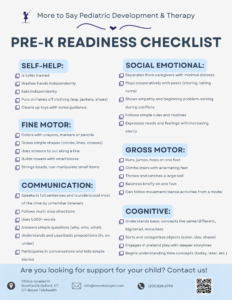
Download this readiness checklist below to track your child’s journey to preparing for Pre-K!